
Reusable incontinence products: a new growth opportunity for private labels?
Just a few years ago, the reusable incontinence and private label market was still relatively limited, within an incontinence category dominated by disposable products and primarily targeting older consumers.
The landscape has since broadened.
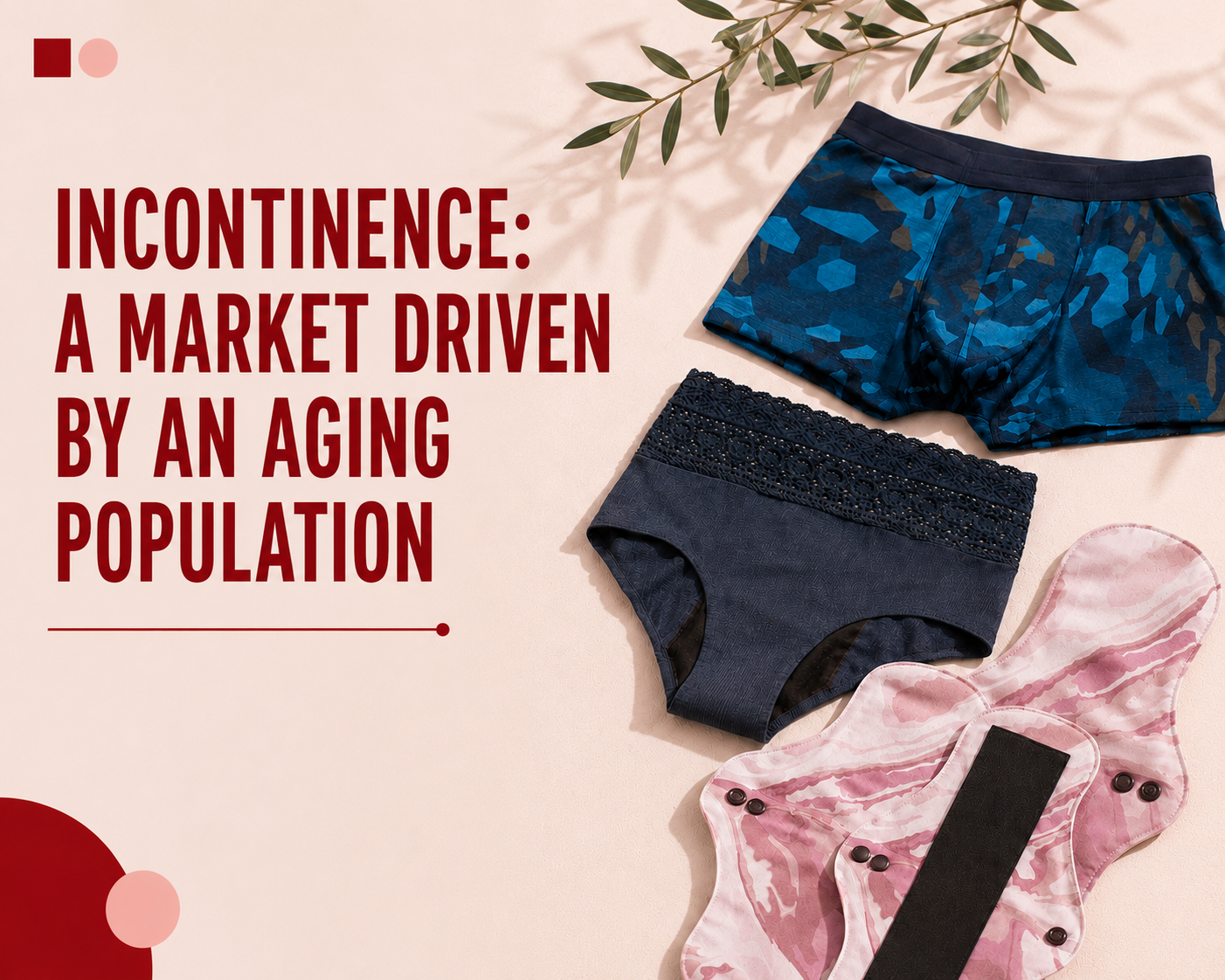
France’s population is ageing, but consumers affected by bladder leaks are also more diverse than one might expect: postpartum women, women going through menopause, people experiencing light leaks during exercise… At the same time, new solutions are making their way onto shelves, including reusable absorbent underwear, washable boxer briefs and reusable bed pads.
For retailers, this shift is taking place within an already dynamic category in which private labels hold a significant position.
Reusable products therefore deserve to be considered as a segment in their own right, with specific uses, technical requirements and recruitment potential.
INCONTINENCE IS BECOMING ONE OF THE GROWTH DRIVERS OF THE HYGIENE CATEGORY
The latest available figures show a clear trend.
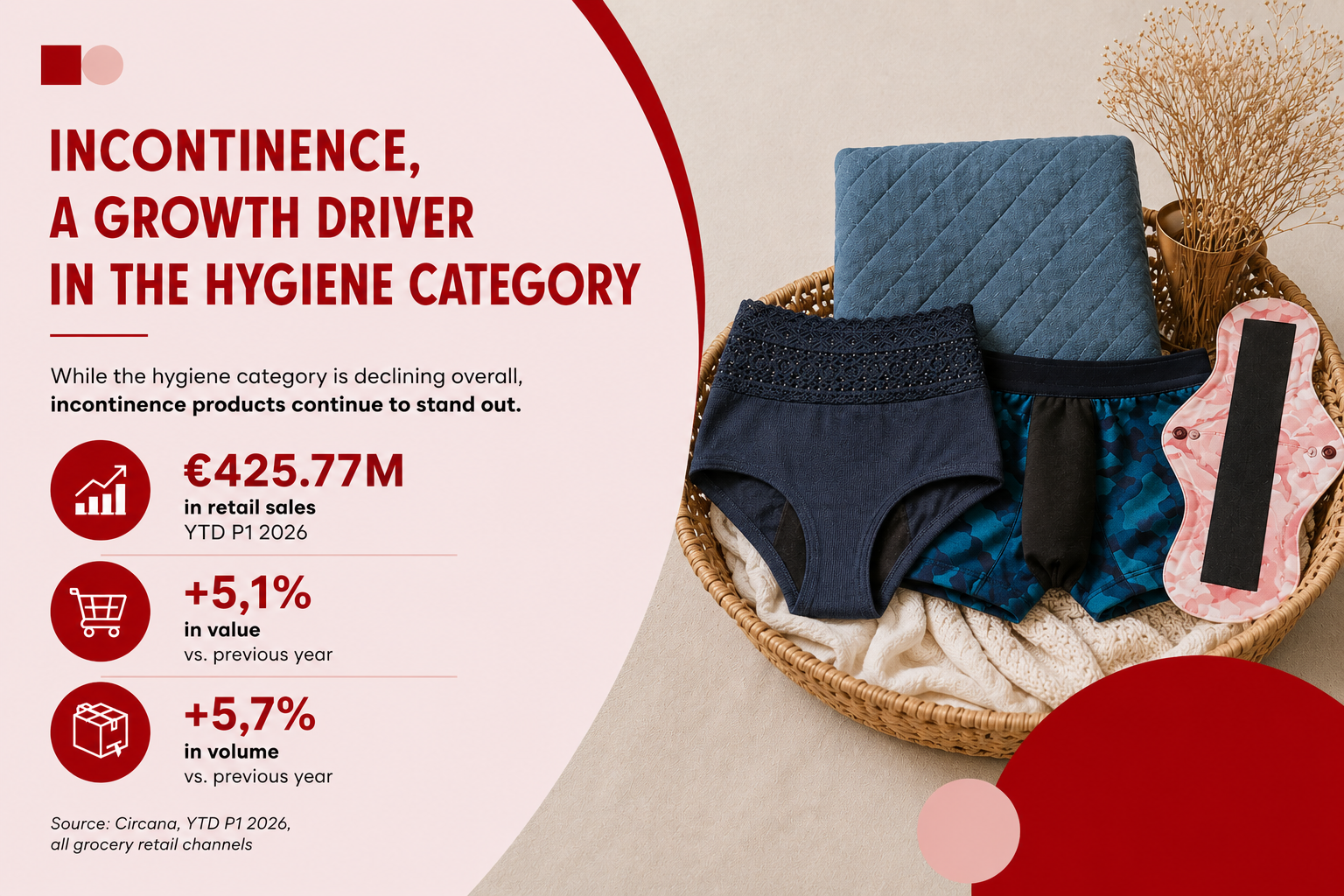
According to Circana, incontinence products generated €425.77 million in French grocery retail, on a MAT basis to P1 2026. Sales increased by 5.1% in value and 5.7% in volume.
This growth contrasts with many neighbouring categories: over the same period, nappies and pull-up pants declined by 5.1% in value, tissues by 4.7% and kitchen towels by 4%.
Incontinence is therefore one of the few segments within paper hygiene where growth is also being driven by volumes.
Demographic change will provide long-term support for the category
The ageing of the French population is one of the structural drivers of the market.
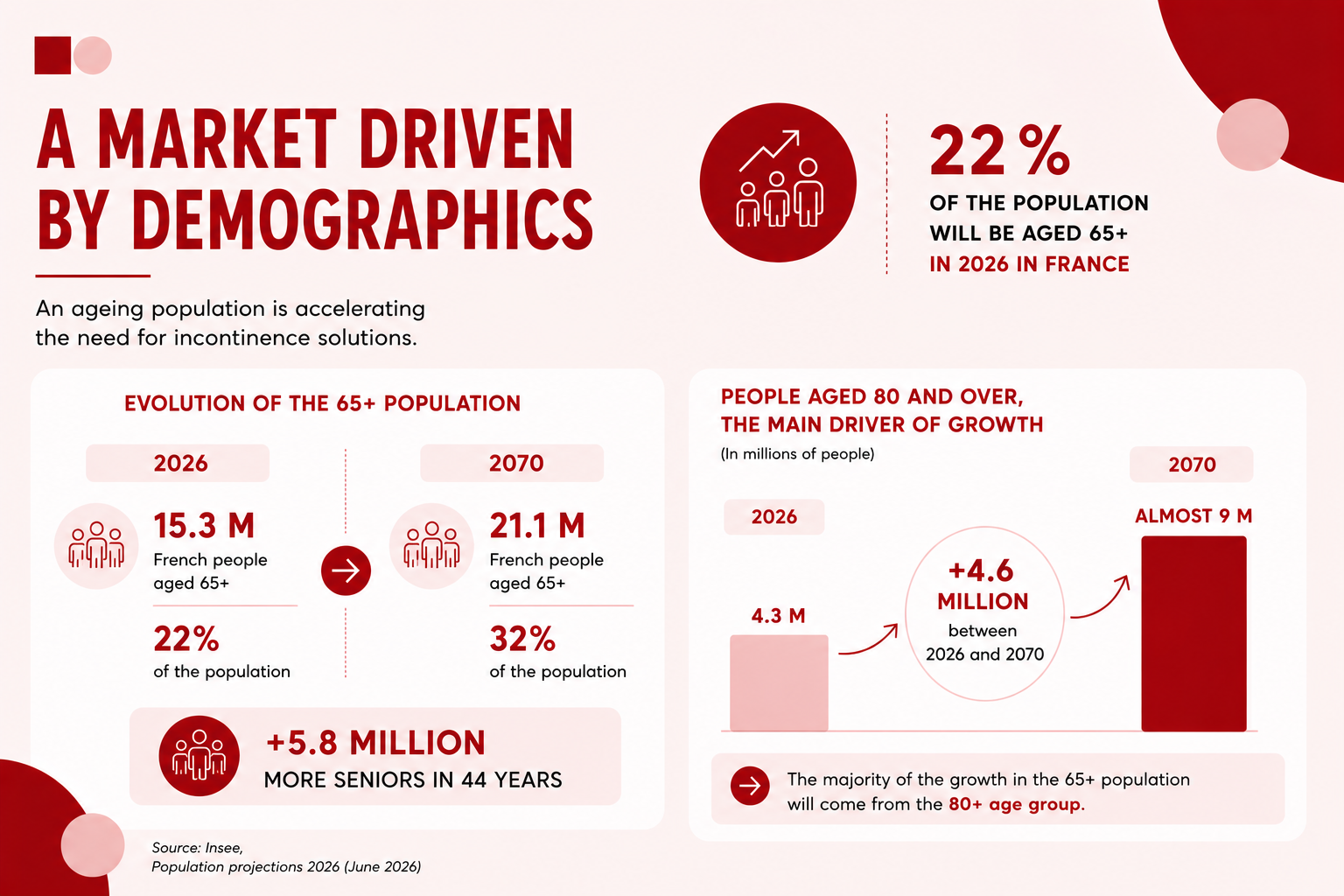
In 2026, 22% of the French population is aged 65 or over. According to population projections published by INSEE, this proportion could reach 32% by 2070.
The number of people aged 65 and over would therefore increase from approximately 15.3 million to 21.1 million.
This trend directly affects categories related to independence, comfort and everyday hygiene. According to France’s national health insurance system, Assurance Maladie, at least 2.6 million people over the age of 65 in France are already affected by urinary incontinence.
But demographic ageing alone does not explain the market’s momentum.
NielsenIQ has also reported growth in the number of consumers among 35-49-year-olds, alongside growth among those aged 65 and over.
The profile of the category’s shoppers is therefore evolving too.
BLADDER LEAKS AFFECT A MUCH BROADER RANGE OF CONSUMERS
Pregnancy and postpartum, menopause, physical activity, ageing and certain medical conditions can all contribute to bladder leaks.
Assurance Maladie notably identifies pregnancy, childbirth and menopause among the factors associated with urinary incontinence.
These situations involve very different needs.
A 40-year-old woman looking for a solution while running will not necessarily approach the category in the same way as someone who uses protection every day for heavier leaks. Purchasing criteria, frequency of use and attitudes towards the product are different.
The structure of sales also shows how diverse the market has become.
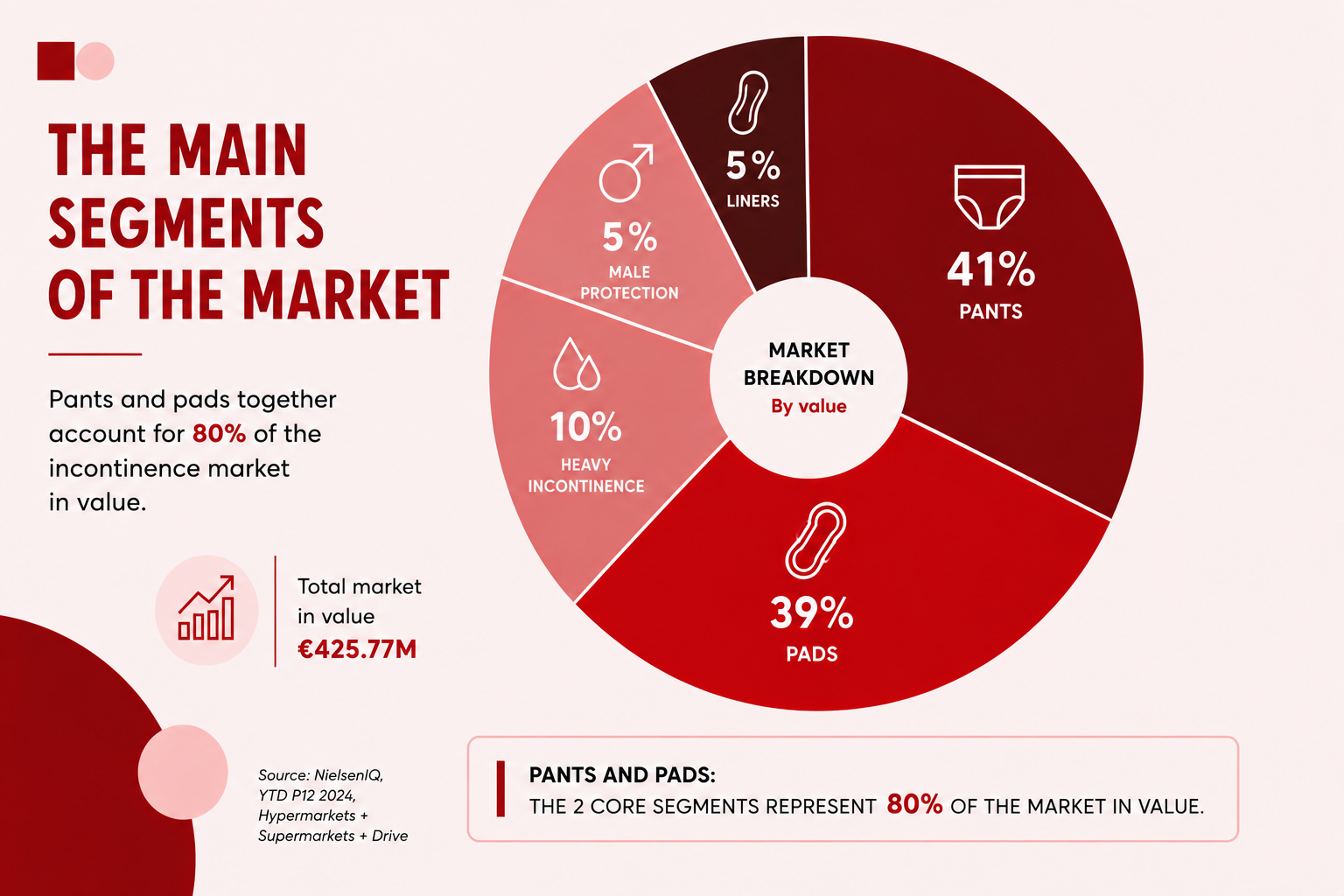
In 2024, incontinence pants accounted for 41% of the market by value, ahead of pads at 39%. Heavy incontinence products represented 10%, while male protection and liners each accounted for 5%.
A GROWING MARKET WHERE THE SUBJECT REMAINS HIGHLY SENSITIVE
Bladder leaks are still far from being a normalised topic.
According to an OpinionWay study conducted in 2025, 89% of French people consider incontinence a difficult subject to discuss.
Furthermore, 32% say that they are directly affected or have a relative who is affected, while more than half of French consumers feel poorly informed about the subject.
This helps explain certain behaviours around light bladder leaks: using conventional panty liners, delaying the purchase of dedicated products or adapting certain activities.
Not everyone experiencing bladder leaks is therefore a regular buyer of products specifically designed for incontinence.
For retailers, this gap between the number of people affected and the number actually purchasing within the category is worth considering.
REUSABLE INCONTINENCE PRODUCTS ARE OPENING UP NEW USES
Reusable absorbent underwear or boxer briefs do not follow exactly the same usage pattern as disposable protection.
For light to moderate leaks, consumers can wear them as everyday underwear, during physical activity or in situations where they want additional protection.
Reusable products can therefore complement disposable solutions rather than systematically replacing them.
This is particularly relevant for consumers who previously relied on non-specialist products or had not yet fully entered the incontinence category.
It also enables retailers to develop an offer tailored to different levels of leakage, uses and consumer profiles.
Still a small segment, but growing rapidly
The segment remains limited in size.
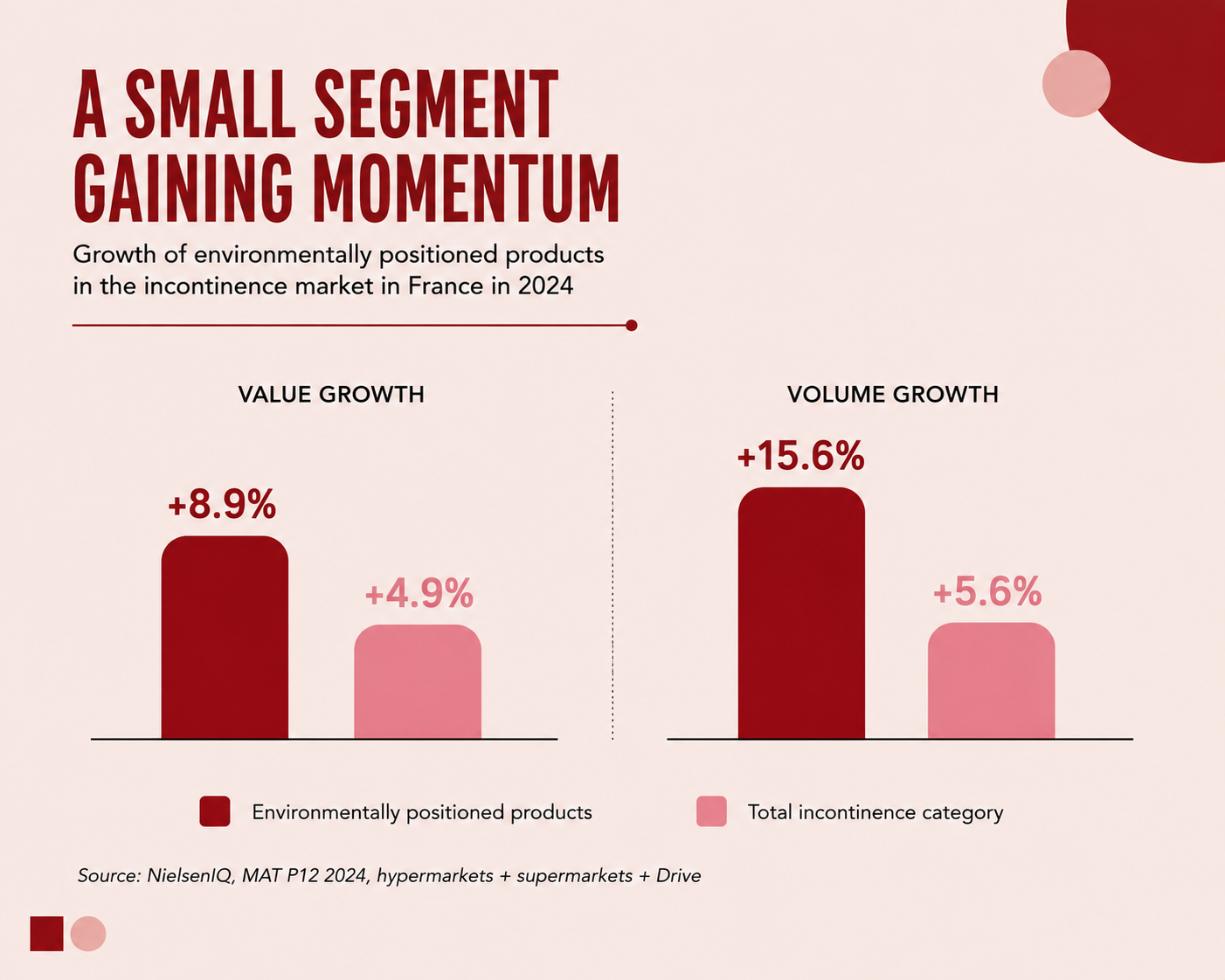
In 2024, environmentally positioned products represented just 1.3% of the incontinence market in both value and units across hypermarkets, supermarkets and Drive.
Their growth rate is nevertheless worth monitoring: +8.9% in value and +15.6% in units, compared with +4.9% and +5.6% respectively for the overall category during the same period.
It remains a niche, but one where volumes are growing almost three times faster than the market as a whole.
BUILDING A REUSABLE INCONTINENCE PRIVATE LABEL RANGE
Private labels are not entering an undeveloped market.
They already represented 37% of the incontinence market by value in 2023, behind the market leader at 43%. Incontinence is therefore a hygiene category in which private labels already have a strong position.
For reusable products, the challenge is less about replicating the existing offer than about building a range that provides clear solutions for different needs.
Segmenting by need rather than age
Ageing will remain a major driver of the category, but a range designed exclusively around senior consumers could overlook part of its potential audience.
The offer can instead address specific needs such as everyday light leaks, physical activity, postpartum, night-time use or male incontinence.
This approach also makes the category less stigmatising. Consumers are looking for an answer to an identifiable situation rather than a product associated with a particular age group.
Several reusable formats are already available on the market: absorbent briefs, boxer briefs, underwear, reusable pads, inserts and washable bed pads. But increasing the number of SKUs is not necessarily the answer. The real question is which needs should be prioritised, with which formats and absorbency levels, depending on the retailer’s positioning and the shelf space available.
With reusable products, performance starts with product construction
Developing a reusable absorbent product requires a number of technical trade-offs.
The product needs to absorb liquid quickly, limit transfer to the outer fabric and maintain a sufficiently dry feeling against the skin. Thinness, breathability, comfort and resistance to repeated washing must also be considered.
These parameters are closely interconnected. Simply adding more absorbent material, for example, can increase thickness and make the product less discreet.
Performance therefore depends largely on the product’s multilayer construction: each layer performs a specific function, from skin contact and absorption to moisture management, the waterproof barrier and the outer textile.
At Kapa Reynolds, our private label product development expertise enables us to work with our manufacturing partners to identify technical solutions suited to the retailer’s requirements, adjusting parameters such as absorbency levels, materials, shapes and finishes.
Underwear designed for light bladder leaks, men’s boxer briefs and night-time protection do not have the same technical requirements.
Wash durability is part of product performance
For a reusable product, performance cannot be assessed only during the first few uses.
Wash resistance, dimensional stability, retention of absorbency, and the durability of seams and elastic components all become essential development criteria.
For consumers, this durability directly affects the value of the product: the benefit of a reusable solution depends on its advertised properties being maintained over repeated use.
Packaging also needs to make the first purchase easier
Reusable products raise more questions at the point of purchase: which absorbency level should I choose? What type of leakage is it designed for? Which size? How should the product be washed? How many washes can it withstand?
For consumers discovering the category, this information needs to be understood quickly, without overloading the front of the pack.
Packaging development therefore involves both the information itself and the way it is prioritised: differentiating absorbency levels, identifying sizes, care symbols, key benefits and ensuring that essential information remains easy to read.
At Kapa Reynolds, our Packaging department works alongside our Marketing and Quality teams from the product development stage, integrating these constraints into the pack design and creating a range architecture that remains easy to understand on shelf.
This readability becomes even more important as the population ages. Font size, contrast, clarity of pictograms and ease of handling can all have a very practical impact on the shopping and user experience.
Omnichannel retail can also help extend the depth of the range: stores can focus on a selection of high-potential products, while online channels can offer a wider choice of sizes, colours, formats and absorbency levels.
AGEING AND NEW USES ARE RESHAPING THE INCONTINENCE MARKET
The growing senior population provides the incontinence market with a long-term demographic driver. But it only tells part of the story.
The category is also recruiting younger consumers, addressing a broader range of situations and beginning to incorporate reusable solutions. For retailers, the challenge will therefore be not only to capture market growth, but also to determine which needs to address and how to make the offer immediately understandable on shelf.
Reusable incontinence products still represent a small part of the market, but their growth and the diversification of consumer profiles make them a segment worth monitoring closely over the coming years.
Kapa Reynolds supports retailers in developing their private label incontinence ranges, from identifying opportunities and sourcing product solutions to packaging development and market launch.
FAQ : REUSABLE INCONTINENCE PRODUCTS AND PRIVATE LABELS
How large is the incontinence market in France?
Incontinence products represent €425.77 million in French grocery retail, according to Circana, MAT P1 2026. Sales are growing by 5.1% in value and 5.7% in volume.
What share of the incontinence market is held by private labels?
Private labels accounted for 37% of the market by value in 2023 across hypermarkets and supermarkets, according to NielsenIQ. They are therefore already a major player in the category.
What share of the incontinence market is reusable?
Environmentally positioned products represented 1.3% of the market in both value and units in 2024 across hypermarkets, supermarkets and Drive. However, they were growing by 8.9% in value and 15.6% in units.
Which reusable incontinence products are available?
The range can include reusable absorbent underwear, boxer briefs, washable pads, inserts and reusable bed pads. Formats and absorbency levels can be adapted to different needs and uses.
How does reusable absorbent underwear work?
Reusable absorbent underwear generally combines several complementary textile layers: a layer in contact with the skin, an absorbent core, a barrier designed to prevent leaks and an outer textile. Construction varies according to the required absorbency level and intended use.
Why develop a reusable incontinence private label range?
Developing a reusable incontinence private label range can help retailers address a broader range of needs, particularly light bladder leaks, while complementing disposable protection.