
K-Beauty and Private Label: ingredients, textures and beauty trends making their way into mass retail
A few years ago, talking about K-Beauty in private label in France would probably have seemed premature. Korean cosmetics were still mostly associated with sheet masks, lengthy beauty routines and a handful of relatively niche brands.
Today, things look very different.
On shelves, we now see Centella asiatica, niacinamide and peptides. Eye patches come in hydrogel formats. Some masks are designed to be worn for several hours and gradually turn transparent during use. And glass skin, a term that was virtually unknown to the wider public not so long ago, has now made its way into the name of a L’Oréal Paris range.
We also see this shift very clearly in our own work. When we meet manufacturers at international trade shows, the new skincare products being presented to us have changed considerably. Classic serums and creams are still there, but alongside them we now see gel textures, patches, overnight treatments, stick formats and ingredients that were barely on the radar just a few years ago.
Some of these innovations will probably remain curiosities. Others are already beginning to move beyond their market of origin.
That is precisely what makes Korean cosmetics so interesting to watch: beyond the trend itself, Korea has become a genuine testing ground for part of the global beauty market.
FROM NICHE PHENOMENON TO GLOBAL MARKET: K-BEAUTY HAS MOVED UP A GEAR
The first wave is nothing new.
As early as the 2010s, South Korea was already exporting concepts that now feel familiar: BB creams, sheet masks, sleeping masks and essences. In France, retailers such as Sephora and Monoprix helped introduce consumers to these new beauty routines.
But the current wave is on a very different scale.
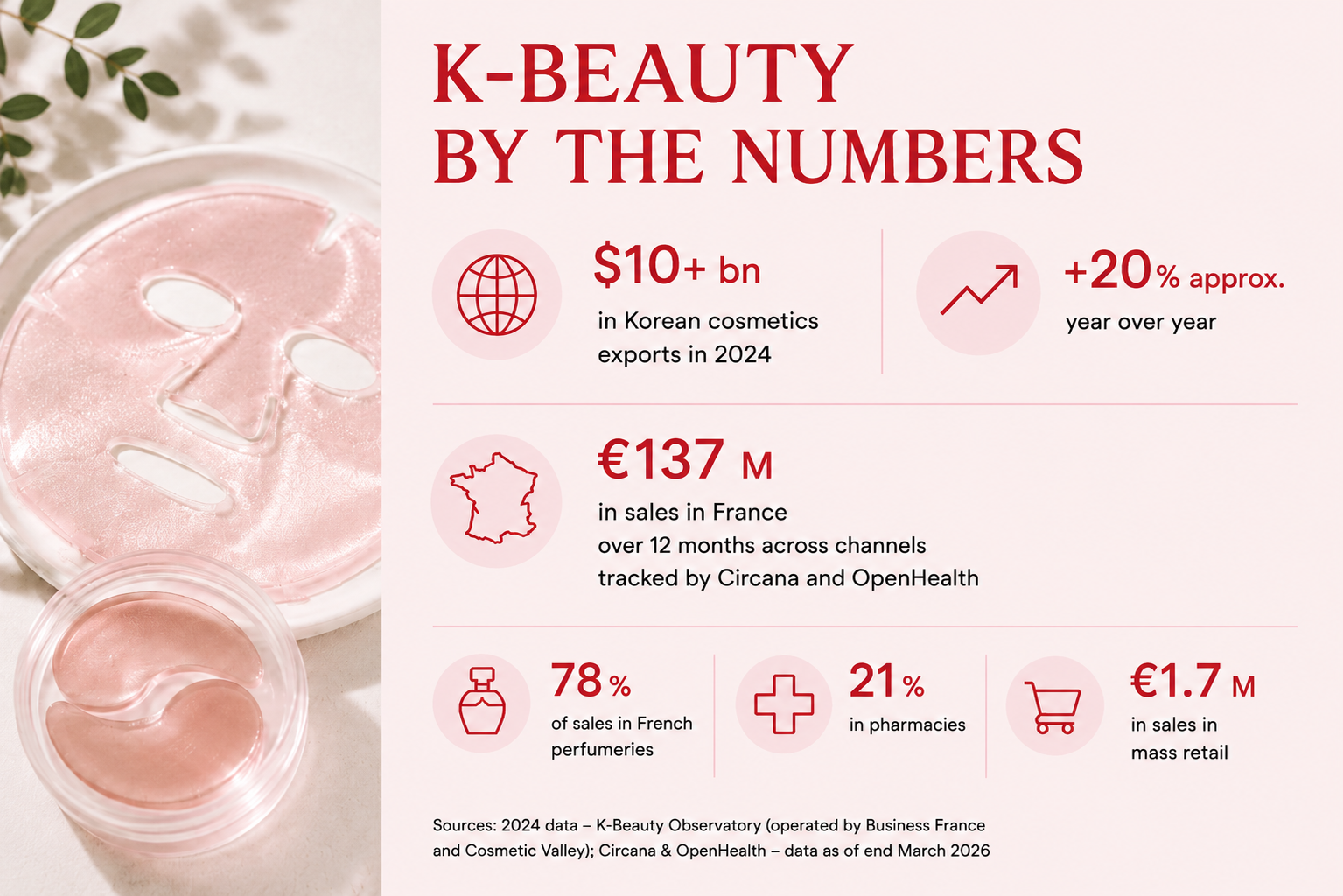
In 2024, South Korean cosmetics exports exceeded $10 billion, up around 20% in a single year. South Korea has consequently established itself as one of the world’s leading cosmetics exporters.
And the momentum continues. Europe is now one of the regions where Korean beauty players are accelerating particularly quickly.
In April 2026, NielsenIQ published an entire report on the global K-Beauty phenomenon, examining how Korean beauty is now influencing innovation, ingredients, categories and distribution models internationally. A few months later, the group reported that K-Beauty value sales had increased by 53% year on year and 131% over two years across the markets analysed.
This is no longer simply a story of Korean brands expanding overseas. Codes that originated or were popularised in Korea are gradually being adopted across the wider cosmetics market.
France is directly part of this shift
Just look at what has happened over the past few years.
Consumers initially discovered many of these brands online or through a small number of specialist retailers. Today, Beauty of Joseon, Biodance, COSRX, Medicube, Torriden and SKIN1004 have become familiar names to a growing number of French consumers.
More importantly, their physical retail presence is expanding.
In 2025, Monoprix reported introducing several COSRX, Stay Well and My Ingredient products into its facial skincare aisles. Specialist retailers are also expanding in France, while pharmacies are beginning to devote more shelf space to Korean beauty.
The French K-Beauty market has now reached €137 million in sales over twelve months across the channels tracked by Circana and OpenHealth. Perfumeries still account for 78% of sales, while pharmacies represent 21% and are growing particularly quickly.
Mass retail remains much smaller, with approximately €1.7 million in sales over twelve months. This means that the market for K-Beauty in private label is still largely to be built.
WHY DOES K-BEAUTY INNOVATE SO QUICKLY?
To understand the phenomenon, we need to look towards Seoul.
Korean consumers are particularly demanding when it comes to skincare. They know their ingredients, compare products, try new launches and change their routines quickly. Digital also plays a major role: in South Korea, more than 70% of cosmetics sales were made online in 2024.
This creates an extremely competitive market.
A different texture, a new ingredient or an original application method can quickly emerge, be tested by consumers, discussed on social media and subsequently adopted by other brands.
K-Beauty has therefore developed a distinctive approach to skincare: a product needs to be effective, but it also needs to make people want to use it.
This may be one of its most interesting contributions to the beauty industry.
A mask that turns transparent while being worn makes the experience visible. A hydrogel patch provides an immediate cooling sensation. A gel texture turns an otherwise conventional treatment into a more sensory experience.
Innovation is no longer hidden solely within the formula. Consumers can see and feel it as soon as they use the product.
CENTELLA ASIATICA, NIACINAMIDE, PEPTIDES… THE INGREDIENTS GAINING GROUND
It would, however, be reductive to summarise K-Beauty solely through its unusual formats.
Another major shift is taking place within formulations.
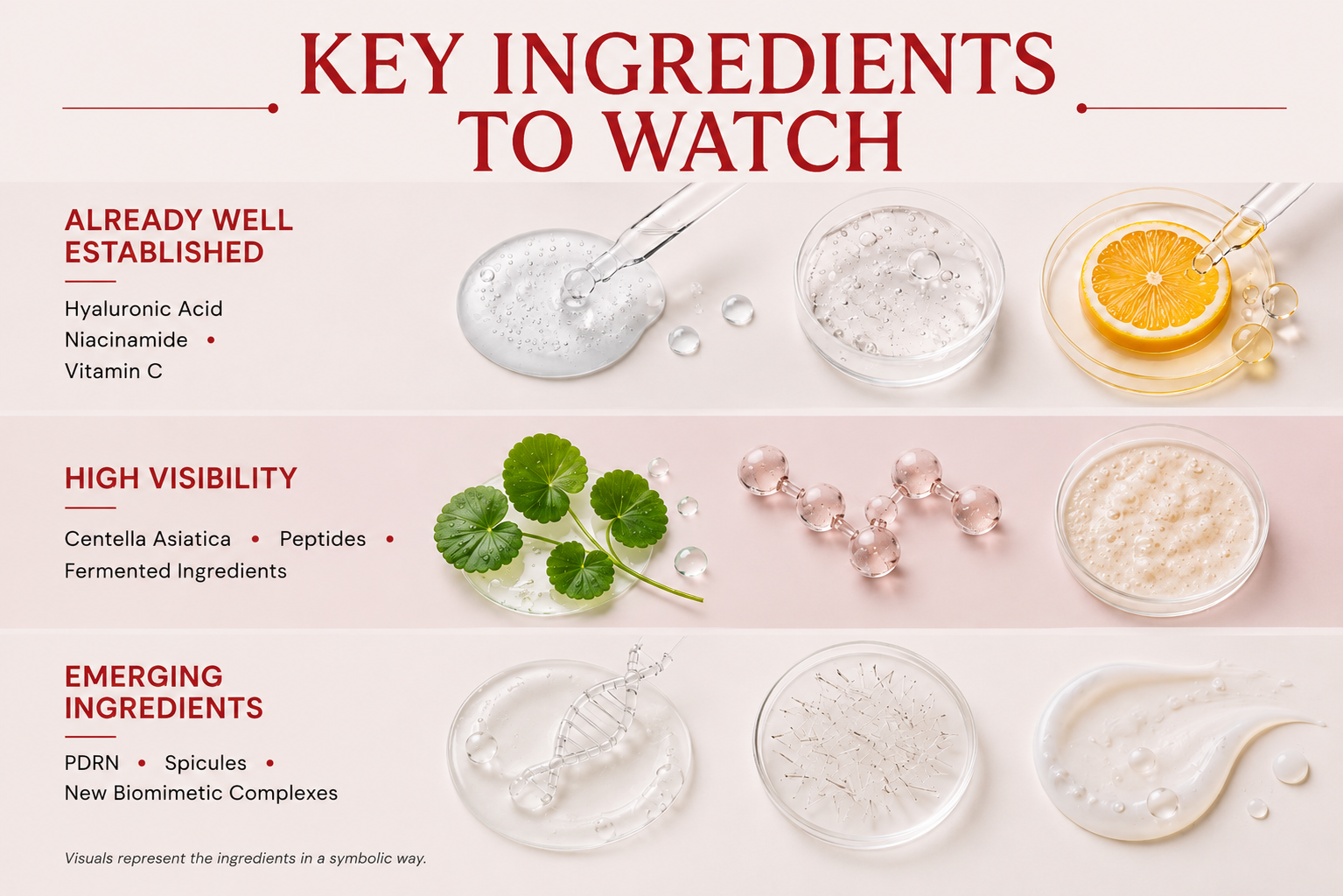
Some ingredients have long been familiar to formulators, but Korean cosmetics have played a major role in bringing them into consumers’ everyday beauty vocabulary. Centella asiatica is a particularly good example.
Centella asiatica: from the INCI list to front-of-pack
Only a few years ago, relatively few consumers would probably have looked specifically for a product because it contained Centella asiatica.
Today, some brands have made it their signature ingredient.
SKIN1004 has built a large part of its identity around Centella from Madagascar. Beauty of Joseon, Purito and COSRX also use it in their skincare products.
Why has it become so popular?
Centella asiatica is strongly associated with soothing and repairing skincare, at a time when the skin barrier has become a much more prominent beauty concern.
Its success also illustrates an interesting marketing shift: the ingredient itself becomes a recognisable signpost on shelf.
Niacinamide and hyaluronic acid: familiar ingredients that remain highly relevant
Alongside ingredients closely associated with Korea are others that are far more universal.
Niacinamide, hyaluronic acid, vitamin C, peptides…
They obviously did not originate with K-Beauty. Yet they feature prominently in Korean beauty routines because they respond well to an increasingly important consumer expectation: quickly understanding what a product is going to do for the skin.
Niacinamide is associated with radiance and a more even-looking complexion.
Hyaluronic acid with hydration and a plumping effect.
Peptides with anti-ageing and firmness.
For an accessible beauty offer, this clarity is valuable. Consumers do not necessarily need to understand the entire formula to identify its main benefit.
This is also an important consideration for K-Beauty in private label: the ingredients selected need to be sufficiently familiar, or easy enough to explain, to work effectively on shelf.
Ferments, PDRN and spicules: ingredients to watch
Then there are the more recent ingredients.
Fermented ingredients have long held a particular place in Korean cosmetics, including Galactomyces and Saccharomyces.
In recent years, another acronym has been appearing with increasing frequency: PDRN.
Initially popularised within Korean aesthetic medicine, PDRN is now appearing in numerous serums and creams. Plant-derived alternatives are also emerging.
Spicules are following a similar path. These microscopic structures are used in some skincare products to create a microneedle-like sensation during application and have become particularly visible through Korean products widely shared on social media.
Does this mean we should expect to see all these ingredients in every mass retail beauty aisle tomorrow? Not necessarily.
Between a trend that works in Seoul or on TikTok and a product that is genuinely relevant to the French market, several questions remain: consumer understanding, European regulations, tolerance, efficacy evidence, price and the ability to communicate the benefit simply.
Not every trend is destined to become mass market.
TEXTURES ARE BECOMING JUST AS IMPORTANT AS INGREDIENTS
This is probably where Korean influence is most visible.
For many years, cosmetics innovation was mainly communicated through ingredients: a new active, a higher concentration, a new combination.
K-Beauty has added another dimension: the texture and delivery system can become the innovation itself.
And one of the best current examples is hydrogel.
From sheet masks to hydrogel masks
Sheet masks were one of the defining products of the first K-Beauty wave.
Hydrogel masks are now taking the concept further.
Their gel-like material moulds to the face and creates a very different experience from a traditional sheet mask. Some products are designed to remain on the skin for several hours, or even overnight. The mask gradually becomes more transparent as it is worn.
That detail may sound insignificant.
It isn’t.
On social media, consumers can literally watch the mask change. The product becomes particularly demonstrative in before-and-after video content without requiring a lengthy explanation.
The Biodance Bio-Collagen Real Deep Mask is probably one of the most visible examples of this trend. Its success has played a major role in introducing the hydrogel format to consumers outside Korea.
And the technology is now moving beyond Korean brands.
In 2026, L’Oréal Paris launched its own Revitalift Filler Glass Skin Hydrogel Mask. The brand explicitly presents the product as inspired by Korean beauty: the mask releases its ingredients and becomes transparent after 90 minutes. Its formula notably highlights hyaluronic acid, Centella asiatica and panthenol.
This is an interesting signal: a format strongly associated with K-Beauty is now being launched by a mass-market beauty brand. For K-Beauty in private label, this type of move into the mass market is particularly useful to watch: consumers are already beginning to recognise the format.
Hydrogel eye patches are following the same path
The eye contour category provides another good example.
Eye patches themselves are nothing new. But hydrogel eye patches have refreshed the category through their sensory appeal, ease of use and strong visual potential.
They also reflect a shift in beauty routines. Rather than systematically adopting a ten-step routine, Western consumers seem more inclined to select specific targeted rituals from K-Beauty.
A mask when the skin needs hydration. Eye patches in the morning. An overnight treatment from time to time.
K-Beauty may therefore be exporting less of a complete routine and more of a library of beauty rituals from which consumers can pick and choose.
“GLASS SKIN”: MUCH MORE THAN A HASHTAG
Among the expressions popularised by K-Beauty, glass skin is probably one of the best summaries of how skincare expectations are evolving.
The goal is not simply to have shiny skin.
“Glass skin” refers to skin that looks smooth, plump, intensely hydrated and luminous, to the point of reflecting light.
This pursuit of luminosity has changed the way skincare efficacy is communicated. The conversation is no longer only about correcting wrinkles or imperfections. The overall condition and appearance of the skin become the promise.
Once again, L’Oréal Paris moving into this territory is telling.
Rather than simply adopting an ingredient associated with Korea, the brand directly uses the term Glass Skin for a Revitalift Filler range presented as inspired by Korea,including a radiance treatment, a fluid and the hydrogel mask.
A few years ago, the concept would probably have required a lengthy explanation.
Today, it can become the name of a product range.
WHEN GLOBAL BEAUTY PLAYERS ALSO LOOK TO SEOUL
Product launches are not the only interesting indicator.
At the end of 2024, L’Oréal announced the acquisition of Dr.G, a Korean skincare brand founded by dermatologist Gun Young Ahn. It joined the Group’s Consumer Products Division, with L’Oréal citing the growing success of K-Beauty and its ambition to expand its portfolio of effective, science-backed and accessible skincare.
Dr.G is not a small niche brand discovered by chance either: according to L’Oréal, it ranks among the top three mass-market and dermocosmetic skincare brands in South Korea.
Another telling development came in January 2026, when Sephora and Olive Young announced a strategic partnership around Korean beauty. Olive Young is one of South Korea’s leading beauty retailers. Dedicated spaces featuring its selection are set to appear online and in Sephora stores across several international markets.
These decisions are obviously being made on a very different scale from French mass retail. But they provide a useful indication of just how closely major global beauty players are now watching brands and innovations coming out of Korea.
K-BEAUTY PRIVATE LABEL: COPYING KOREAN BEAUTY CODES WOULD PROBABLY BE THE WRONG APPROACH
For a private label, the objective is not to recreate a Korean beauty aisle product for product.
A viral €20 or €30 product sold through a specialist beauty retailer does not automatically make sense in mass retail.
Is the benefit immediately understandable? Does the application method genuinely add something compared with the existing offer? Can the product be offered at a price point consistent with private label positioning? Is the ingredient compatible with European regulatory requirements and the retailer’s own specifications? Do we have the necessary testing to substantiate the claims? And above all: will the product still make sense once the initial hype has passed?
This is precisely the approach behind our private label product development expertise: market analysis, sourcing, innovation, product development, quality control, supply chain and marketing support.
The hydrogel mask is a good example. It brings together several codes that are currently gaining ground: immediately visible technology, an easy-to-understand application, a strong sensory dimension and ingredients that consumers already recognise.
Conversely, a highly viral ingredient that is difficult to explain, expensive or complex from a regulatory perspective may be far less relevant for a mass-market offer. And once a product has been approved, there is still the challenge of securing its launch into mass retail, from production through to warehouse delivery.
K-Beauty in private label is therefore not about reproducing everything that works in Korea. It is about identifying innovations that are mature enough to be adapted to French consumer expectations and the realities of mass retail.
SO, WHAT WILL BE THE NEXT K-BEAUTY INNOVATION TO REACH MASS RETAIL?
It is impossible to know in advance which trends will become firmly established.
But several signals are already visible.
Centella asiatica has moved beyond the beauty expert community. Hydrogel eye patches are becoming more mainstream. The hydrogel mask is reaching major beauty brands. Glass skin is now being used in mass-market consumer communication. And ingredients such as PDRN are beginning to enter beauty conversations in Europe.
A few years ago, sheet masks also seemed highly exotic.
Today, nobody is surprised to find them in a supermarket.
For K-Beauty in private label, the challenge will therefore be less about following every new trend and more about identifying those that can genuinely become lasting consumer habits.
The next innovation that will one day seem completely ordinary may already be sitting on a shelf in Seoul.
FAQ: K-BEAUTY AND COSMETICS TRENDS
What is K-Beauty?
K-Beauty refers to cosmetics products, practices and trends originating in South Korea. It is particularly influential in facial skincare, with formats including sheet and hydrogel masks, essences, patches and overnight treatments.
Why are Korean cosmetics so successful?
Their success is driven by several factors, including a fast pace of innovation, original textures, a strong skincare culture, often accessible price points and highly effective social media communication. The international spread of Korean culture has also helped increase their visibility.
Which K-Beauty-inspired cosmetic ingredients should we watch?
Some of the most visible ingredients currently include Centella asiatica, niacinamide, peptides, fermented ingredients and, more recently, PDRN. However, not all of these ingredients are specific to Korean cosmetics.
What is a hydrogel mask?
A hydrogel mask is made from a gel-like material that conforms to the shape of the face and contains a formula rich in moisturising agents and active ingredients. Some newer generations are designed for extended wear and gradually become transparent.
Is K-Beauty already present in mass retail?
Yes, although its share remains limited compared with perfumeries and pharmacies. Its presence is nevertheless growing, both through the arrival of Korean brands and through the adoption of K-Beauty-inspired technologies, ingredients and trends by established mass-market beauty brands.