
Private label logistics: why it determines the success of a product launch in retail
PRIVATE LABEL PRODUCT LAUNCH: A BALANCE THAT GOES BEYOND THE PRODUCT
In retail, private label logistics is rarely the first factor considered when launching a product. Discussions tend to focus more on the product itself, pricing, or innovation. Private label tenders are still largely driven by product specifications and cost.
Once these elements are validated, differences between suppliers often become minimal.
The real difference lies elsewhere.
From project validation to in-store availability, a private label launch typically takes 9 to 12 months. During this time, multiple iterations take place between procurement, quality, packaging, and suppliers. Each adjustment can impact the timeline, sometimes significantly.
As highlighted in our analysis of changing consumption patterns in retail, purchasing occasions are becoming more fragmented, and launch windows are narrowing.
A good product, poorly executed, remains a failed launch.
PRIVATE LABEL LOGISTICS: AN INCREASINGLY CONSTRAINED ENVIRONMENT
The logistics behind a private label launch has become significantly more complex in recent years.
Supply chains remain highly dependent on international flows. As highlighted in the UNCTAD maritime transport report, lead times and costs remain volatile due to geopolitical tensions, port capacity constraints, and demand fluctuations.
At the same time, last-mile delivery relies heavily on road transport. In France, it accounts for nearly 90% of freight transport, making it a key factor in product availability in retail.
Beyond lead times, cost is becoming a central issue. Industry analyses, including those from Prologis, indicate that supply chains will remain under pressure in 2026, with sustained high logistics costs.
In this context, logistics is no longer just an execution function — it becomes a key economic driver of the project.
Large-scale physical flows at the core of private label launches
Behind every private label launch lies a tangible operational reality.
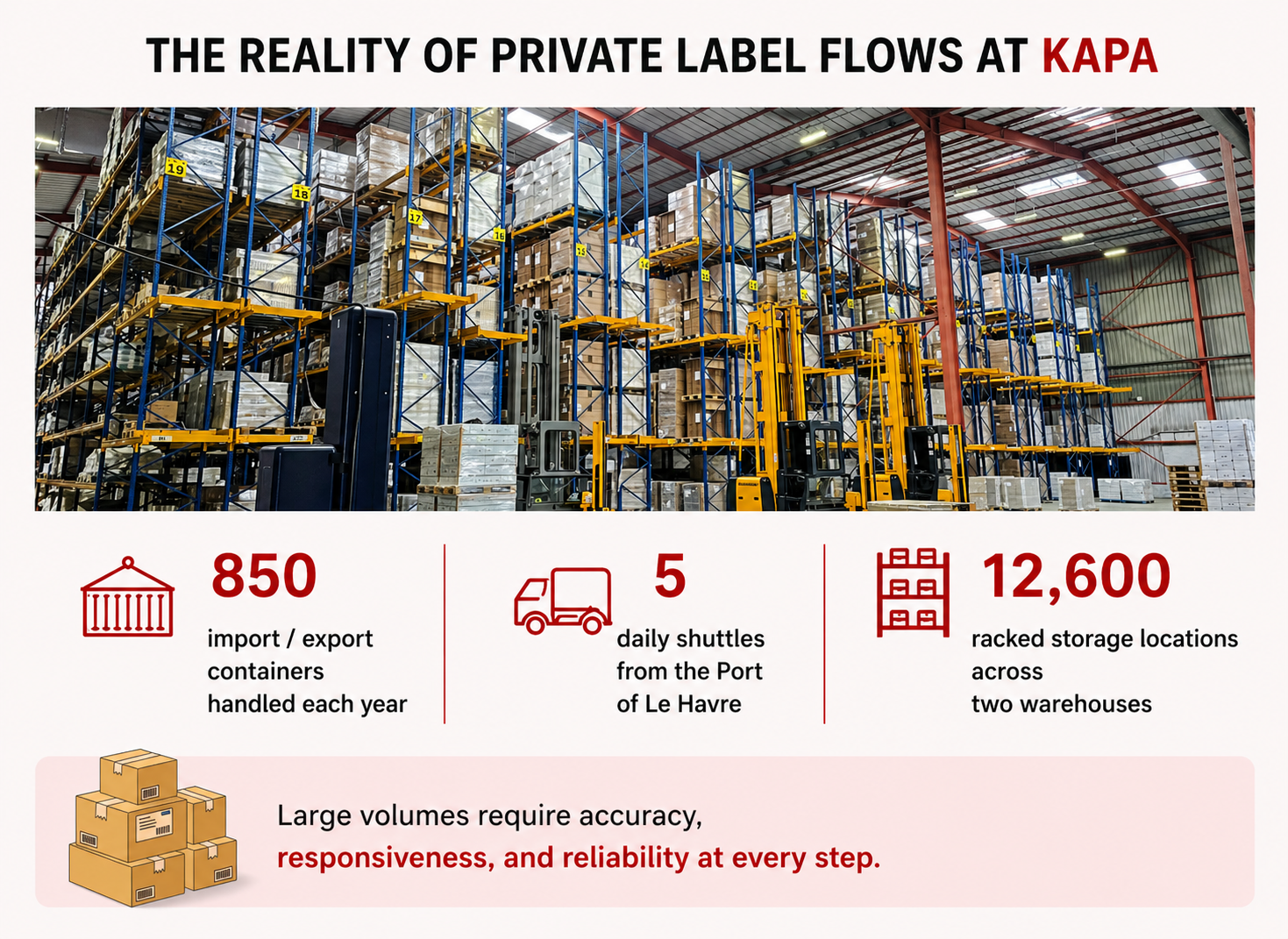
At Kapa, this represents:
- approximately 850 import/export containers handled each year
- up to 5 daily shuttles from the port of Le Havre
- more than 12,600 racked storage locations across two warehouses
As a reference point, a single container can hold tens of thousands of units.
A delay on just one flow can impact several weeks of in-store availability.
A supply chain made of multiple transformations
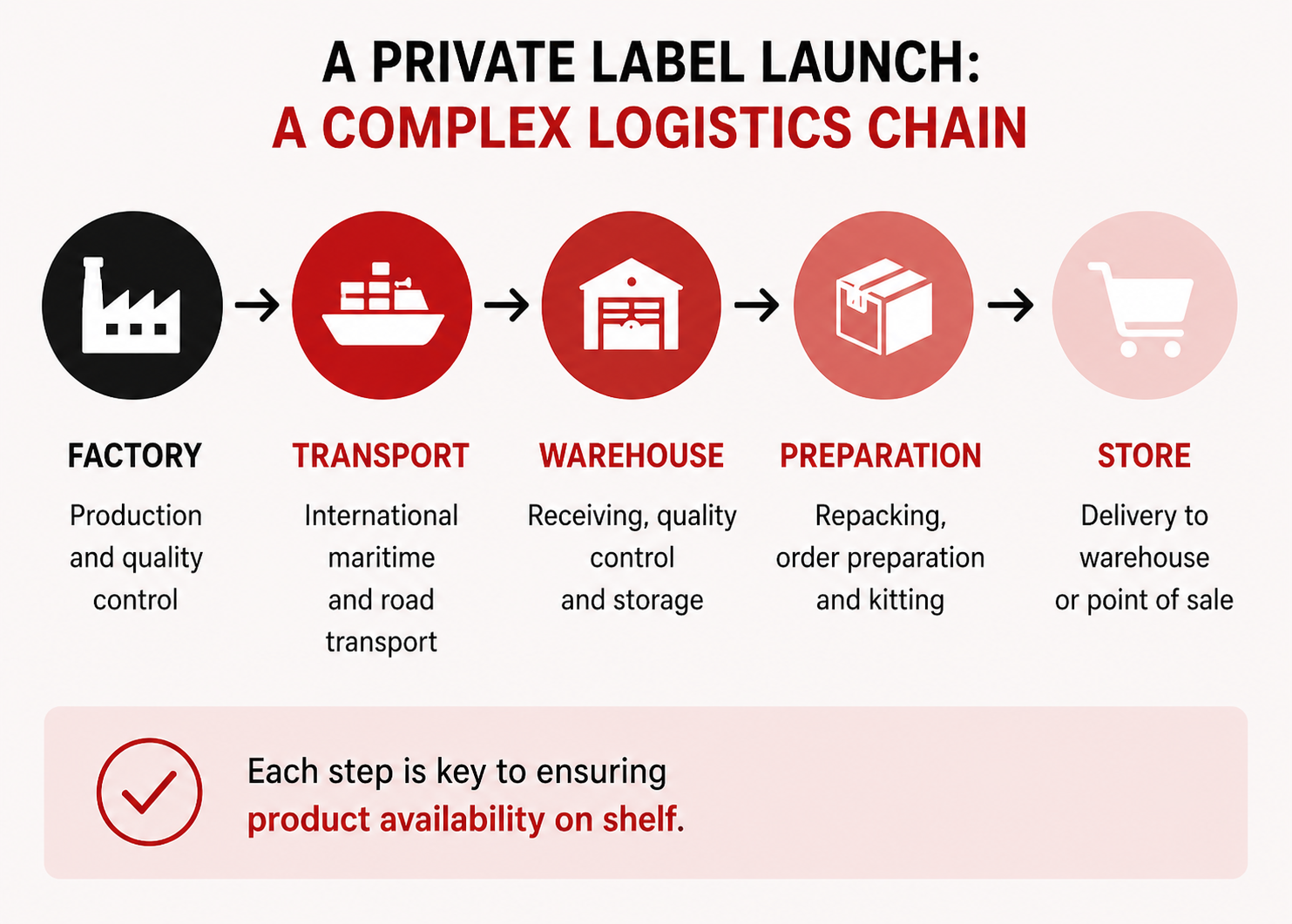
A product does not move directly from factory to shelf.
It follows a structured process:
- unloading
- quality control
- storage
- reconfiguration into logistics units
- order preparation
- shipment
In practice, a product may be handled multiple times before delivery.
As highlighted by ADEME, logistics today must deal with increasing complexity, driven by the multiplication of stakeholders and operational steps.
Each touchpoint becomes a potential risk point.
FLOW FLUIDITY: A KEY PERFORMANCE DRIVER IN RETAIL
Logistics performance does not rely solely on storage capacity. It depends primarily on flow fluidity.
Within a warehouse, inbound and outbound flows must be continuously synchronized. Any imbalance can create bottlenecks and slow down the entire operation.
At Kapa, the organization is designed to maintain continuous flow, with tools adapted to handle high volumes while ensuring precise order preparation.
The challenge is not only speed, but avoiding bottlenecks.
Specific constraints in retail distribution
Retailers add another layer of complexity.
Logistics must adapt to:
- deliveries to warehouses or directly to stores
- specific preparation formats
- tight lead times (sometimes within 48 hours)
At the same time, freight flows are becoming increasingly fragmented.
Data from the French Ministry for Ecological Transition shows that logistics systems are becoming more complex as distribution channels multiply.
Logistics can no longer be standardized — it must be adaptable.
A logistics sector under pressure
Beyond operational constraints, the logistics sector itself is under pressure.
Recent industry reports highlight ongoing tension, with major challenges around costs, volumes, and flow management.
This reinforces the need for controlled and reliable execution.
STOCK-OUTS IN RETAIL: A DIRECT IMPACT ON PERFORMANCE
Product availability remains a key issue in retail.
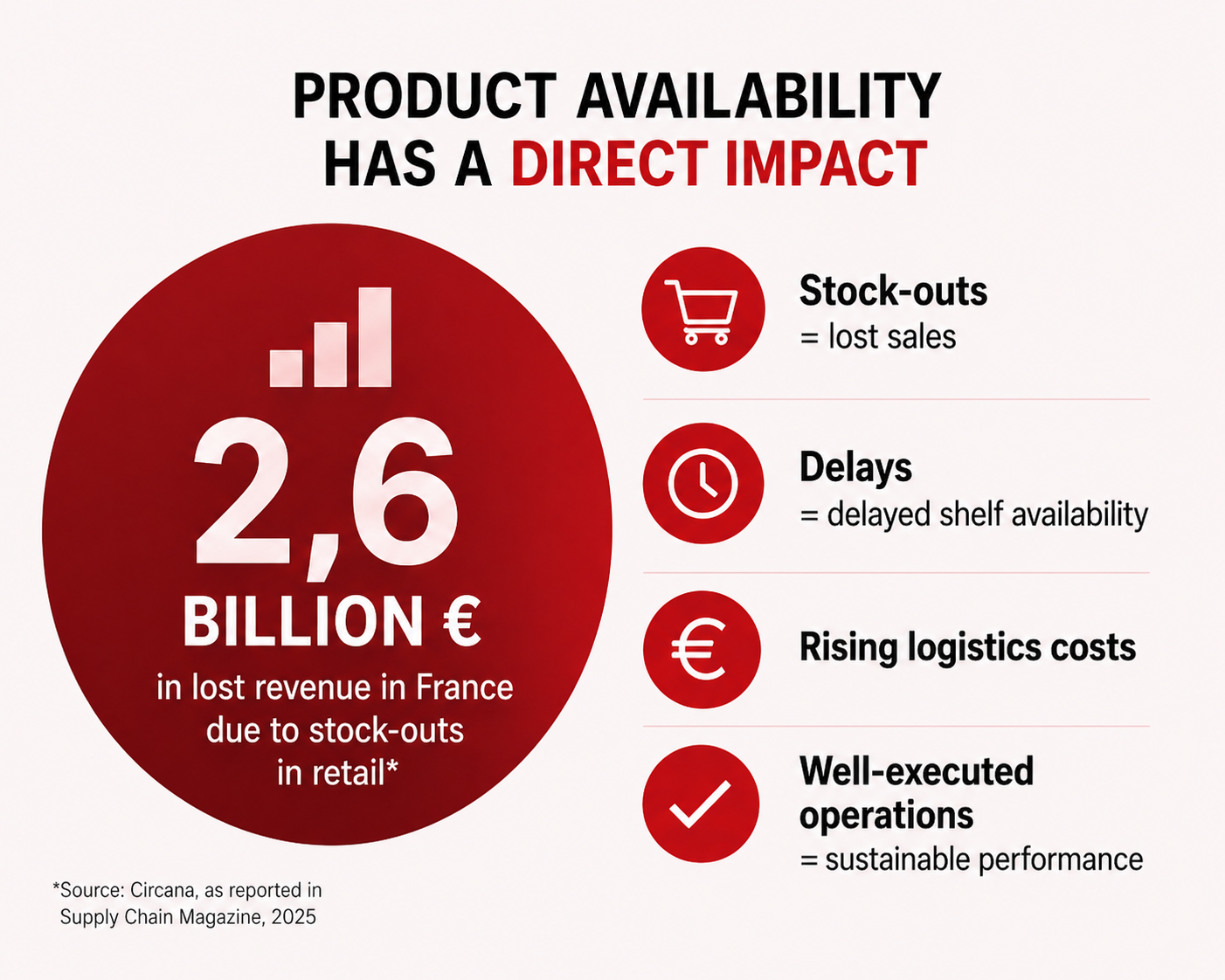
According to a recent Circana analysis relayed by Supply Chain Magazine, stock-outs still represent €2.6 billion in lost sales in France, with two-thirds occurring in hypermarkets.
This clearly shows how private label logistics directly impacts commercial performance.
In this context, a poorly executed launch — with delays or early stock-outs — can significantly undermine a product’s long-term success.
PRIVATE LABEL SUPPLIER: SECURING EXECUTION BEYOND THE PRODUCT
In this environment, the role of the supplier is evolving.
It is no longer just about offering a competitive product, but about securing the entire logistics chain.
As detailed on our dedicated page about our private label product development expertise, this approach relies on a global view of flows, from sourcing to delivery.
An organization designed to handle real volumes
Today, at Kapa:
- more than 50% of volumes are dedicated to external clients
- multiple flows are managed simultaneously
- preparation formats are adapted to retailer requirements
This capacity allows us to absorb demand fluctuations and secure product launches.
From logistics to commercial performance
Well-managed logistics enables:
- adherence to timelines
- consistent product availability
- cost optimization
Conversely, poorly managed logistics quickly becomes a performance risk factor.
CONCLUSION: WHAT DOESN’T SHOW ON SHELVES MAKES ALL THE DIFFERENCE
Logistics is often seen as a support function. However, in the context of private label launches, it directly determines project success.
It is not visible on the shelf, but private label logistics drives:
- product availability
- commercial performance
- customer experience
At equal product and price, the difference often lies in execution capability.