
IFS Broker certification: building trust with major retailers
The product has been sourced, the first samples look promising, and the price meets the retailer’s expectations. The project is off to a good start !
But before this new product reaches store shelves, several questions still need answering. Can the manufacturer deliver the required volumes ? Have the product’s claimed performance levels been demonstrated ? Is the regulatory documentation compliant ? And what assurances can the supplier provide regarding its reliability ?
These questions regularly arise when developing private-label products. They become particularly important when working across categories as varied as adhesive bandages, household cleaning products and cosmetics, each with its own technical and regulatory requirements.
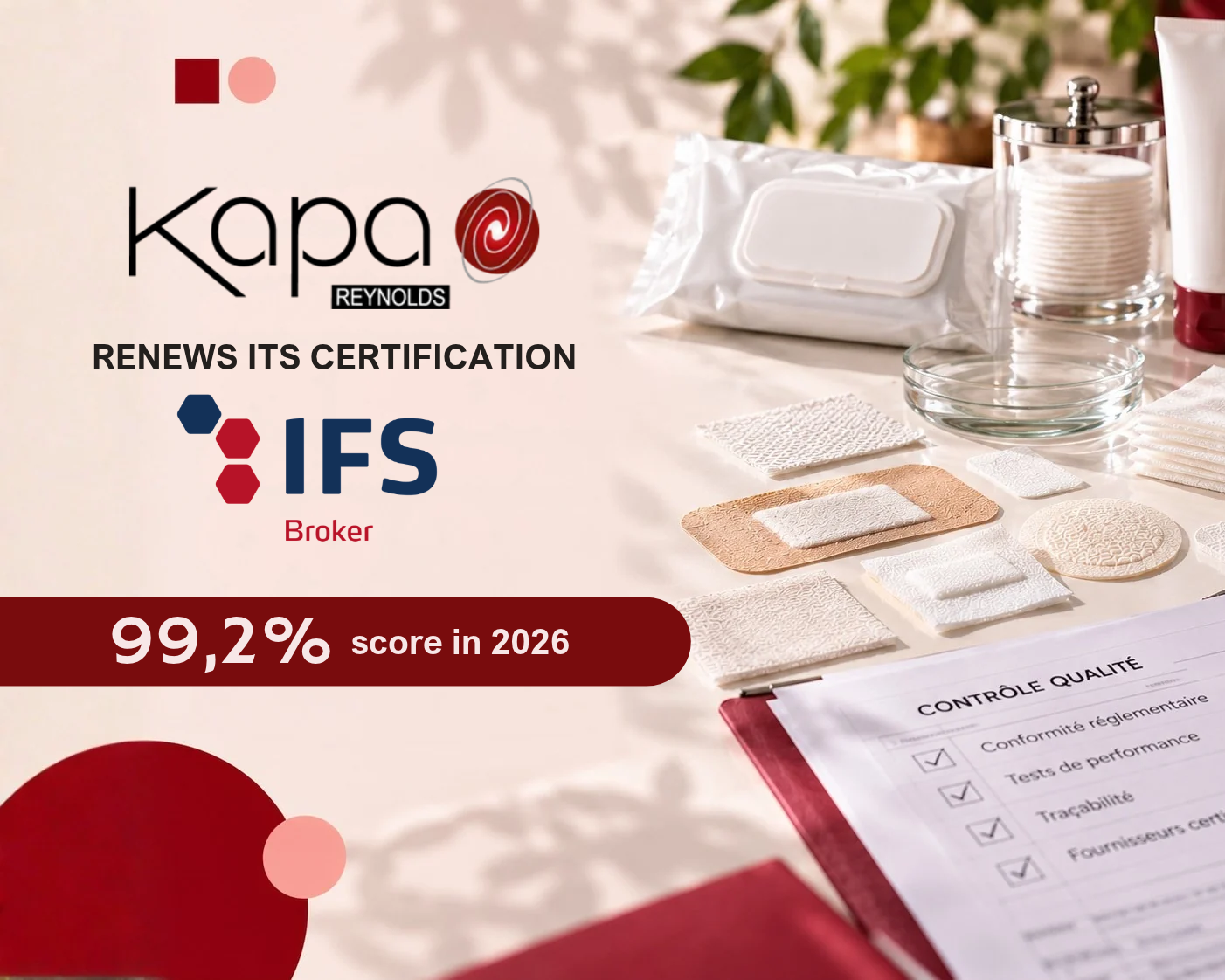
At Kapa Reynolds, manufacturer selection and quality monitoring are integral to our private-label product development expertise. Our IFS Broker certification, renewed in October 2026 with a score of 99.2%, recognises the processes we have established to manage these requirements.
But what does this certification actually mean for retail buyers and product managers ?
SELECTING A PRIVATE-LABEL SUPPLIER: LOOKING BEYOND PRICE AND SAMPLES
Imagine two manufacturers offering a range of adhesive bandages with similar specifications. Their samples appear comparable, their prices are competitive, and their proposed lead times fit the launch schedule.
At first glance, there is little to distinguish them.
However, a closer look at their technical documentation may reveal important differences. One manufacturer provides detailed test reports and recognised certifications. The other submits less comprehensive documentation, requiring further checks.
Supplier selection cannot therefore be based solely on first impressions or price.
Verifying product performance beyond the initial samples

Let’s take adhesive bandages as an example. Two products may look almost identical while performing differently in use.
Adhesion, backing material breathability and the absorbency of the wound pad can all affect product performance.
And these differences are not always apparent during initial testing.
For reusable absorbent underwear, the challenge is slightly different. An absorption demonstration may look convincing, but what happens after several washes ? Does the product maintain its performance over time ?
Performance testing, technical specifications and test reports provide a more complete picture than a visual inspection alone.
Depending on the product category, additional testing may be needed to verify the claimed characteristics.
Manufacturer reliability matters just as much as product quality
A manufacturer may offer an excellent product but lack the production capacity to meet a retailer’s volume requirements. Conversely, a highly efficient production facility may not meet certain regulatory or documentation requirements.
Private-label supplier selection therefore involves several considerations: product quality, regulatory compliance, production capacity, quality management, responsiveness, and social and ethical practices.
Kapa Reynolds follows a structured supplier evaluation process involving expertise from different teams within the company.
This approach helps us assess manufacturers’ ability to meet project requirements and support product development over the long term.
Find out more about Kapa Reynolds’ commitments to product quality and supplier selection.
IFS BROKER CERTIFICATION: WHAT IS IT AND WHY DOES IT MATTER?
IFS Broker is a certification standard designed for trading companies, importers and intermediaries that select manufacturers and market products without necessarily manufacturing them themselves.
It assesses how these businesses organise and manage their operations, particularly in terms of product quality, safety and compliance with applicable requirements.
For suppliers working with major retailers, the standard provides an independent assessment of their management systems by a certification body.
What does an IFS Broker auditor check ?
During an audit, having well-written procedures is not enough. The auditor also checks whether they are being applied in practice.
For example, an auditor may request the documentation for a particular product, review the records used to assess a manufacturer, or examine how a customer complaint was handled.
Product traceability may also be assessed: if an issue concerns a specific batch, the company must be able to retrieve the information needed to identify it and investigate the situation.
The standard covers areas including supplier selection and monitoring, product specification management, traceability, non-conformity management and continuous improvement.
These requirements are designed to help businesses manage the risks associated with the products they market.
Certification does not mean that an incident can never occur. It confirms that the company’s management system has been assessed against a recognised standard, within the scope of its certification.
For further information, consult the official IFS Broker standard.
99,2 % : KAPA REYNOLDS RENEWS ITS IFS BROKER CERTIFICATION
In October 2026, Kapa Reynolds renewed its IFS Broker certification, version 3.2, with a score of 99.2%.
This is a well-deserved recognition of the work carried out throughout the year to maintain and improve our quality management procedures.
This year’s audit was primarily prepared and coordinated by Christina, our Quality Assurance & Regulatory Affairs Officer, with the support of Aude, our Quality & Packaging Director.
Other departments also contributed by answering the auditor’s questions and providing the necessary documentation.
Quality is a team effort
Consider a common situation in private-label product development: a manufacturer proposes changing a component to reduce costs or simplify production.
The proposal may look attractive on paper. But before approving the change, its potential impact on product specifications, available test results and packaging information needs to be assessed.
Several teams may be involved, including product development, sourcing, sales and quality assurance.
Each brings its own expertise to ensure the product continues to meet the project’s requirements.
This cross-functional approach is particularly important at Kapa Reynolds, as our activities span several product categories and different regulatory environments.
Our 99.2% audit score recognises the work carried out by Christina, Aude and the teams involved in maintaining these processes.
PRODUCT TRACEABILITY: FROM MANUFACTURER TO RETAILER
Once a product has been developed and approved, quality monitoring continues through to its commercialisation.
For a single private-label product, several production batches may be manufactured and delivered over time. It is therefore important to be able to identify the products concerned and retrieve information relating to their manufacture and distribution.
Private-label product traceability helps establish the link between a product reference, its production batches, the associated documentation and the deliveries made.
It also facilitates communication between the manufacturer, supplier and retailer whenever additional checks are required.
The ability to retrieve reliable information is one of the areas assessed under IFS Broker certification. For retailers, it helps ensure that product references can be effectively monitored throughout their time on the market.
HOW CAN RETAILERS ASSESS THE RELIABILITY OF A PRIVATE-LABEL SUPPLIER ?
Certifications are a useful consideration when selecting a business partner, but they do not replace an assessment of the product itself or the manufacturer’s capabilities.
An IFS Broker-certified supplier should be able to provide documentation appropriate to the product categories it markets and substantiate the characteristics of the products it offers.
Before starting a new development project, retail buyers and product managers may want to ask:
- Does the supplier hold certifications relevant to its activities?
- How does it select and monitor its manufacturing partners?
- What tests support the product performance claims?
- How are changes to product specifications managed?
- What procedures are in place to handle complaints or non-conformities?
These considerations are particularly important when developing products across categories with very different requirements, such as medical devices, cosmetics and household cleaning products.
With its IFS Broker certification renewed at 99.2%, Kapa Reynolds reaffirms its commitment to quality management and the ongoing monitoring of its private-label developments.
Our aim is to support retailers with products that meet their requirements, combining product expertise, manufacturer selection and quality monitoring.
Looking to develop a new private-label product ?
At Kapa Reynolds, we help retailers develop private-label products tailored to their specifications, from manufacturer selection through to quality monitoring.
Discover our product development and sourcing expertise and let’s discuss your project.
FAQ – IFS BROKER CERTIFICATION AND PRIVATE-LABEL PRODUCT QUALITY
What is IFS Broker certification ?
IFS Broker is a certification standard for trading companies, importers and intermediaries. It assesses their quality and product safety management systems, including supplier selection, traceability, specification management and non-conformity handling.
Why choose an IFS Broker-certified private-label supplier ?
IFS Broker certification provides an independent assessment of a supplier’s management system. It is a useful consideration for retail buyers and product managers, alongside the technical and regulatory checks required for each product.
What is the difference between IFS Broker and IFS Food ?
IFS Broker applies to companies that purchase and market products without necessarily manufacturing them. IFS Food covers food processing and packing activities within the scope of that standard.
How can retailers assess the reliability of a private-label supplier ?
A private-label supplier can be assessed based on its certifications, product quality and performance, regulatory compliance, production capacity, quality management systems and ability to handle customer complaints.