
Declining birth rates: rethinking the Baby Care Category through emerging consumer uses
As the parliamentary mission on declining birth rates has just presented 37 proposals to revive births in France, demographic issues are now at the center of public debate.
A few weeks earlier, INSEE revealed in its latest demographic report that 2025 marked a historic turning point: for the first time since 1945, more deaths than births were recorded in France. It was the first peacetime year in which the natural population balance turned negative.
Widely covered in the media and highlighted by Nielsen and Circana in their latest consumer reports, this trend inevitably raises strategic questions for large-scale retail. How should the Baby Care Category evolve in response to structural demographic change?
Should this be seen as the “end” of the baby category as we know it, or rather as a deeper signal about evolving household consumption patterns?
Declining birth rates: a structural shift in consumption
Key figures to consider
INSEE reported 645,000 births versus 651,000 deaths in 2025, resulting in a negative natural balance (-6,000).
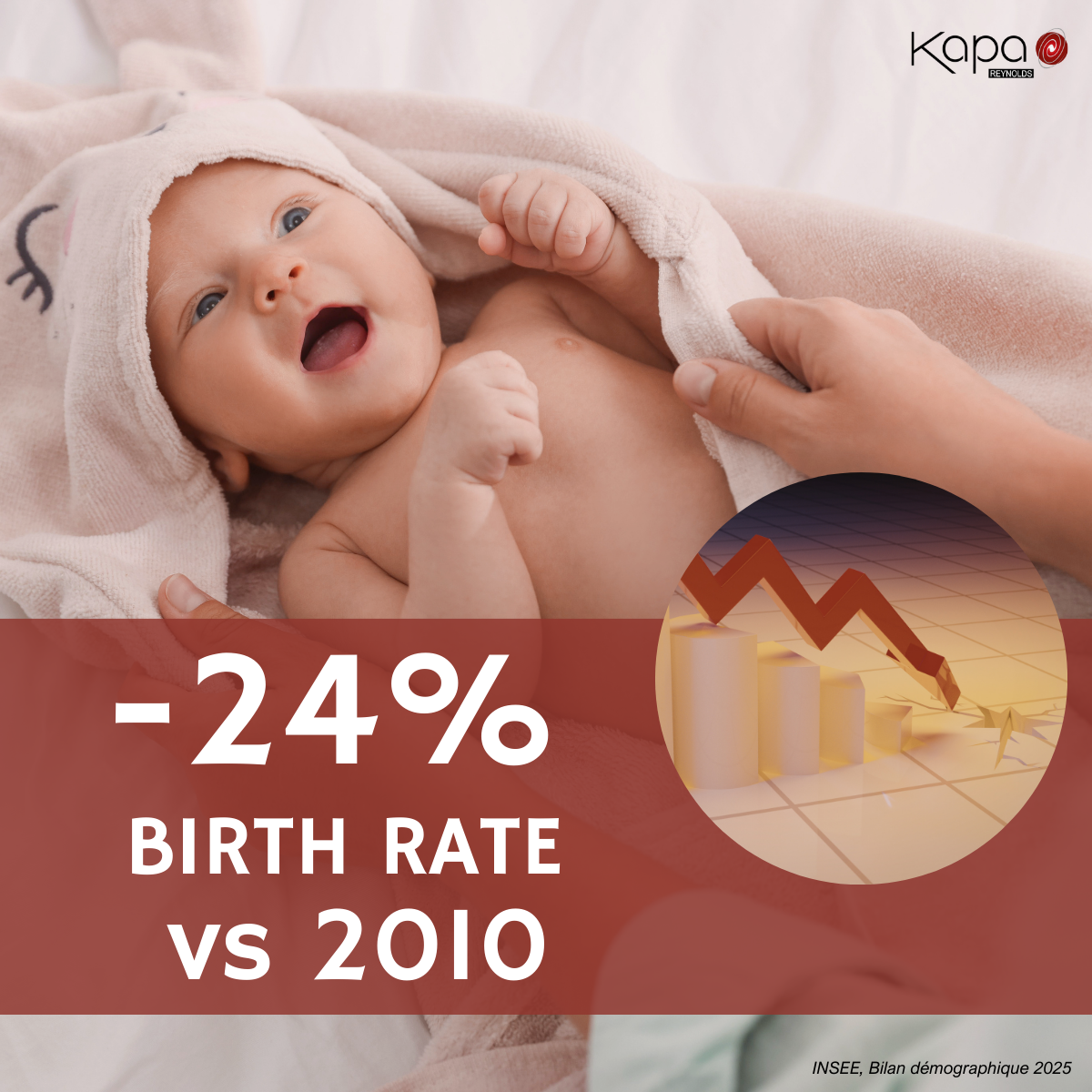
Although births declined by “only” 2.1% compared to 2024, the long-term trend is clear: since 2010, births have fallen by 24%.
The fertility rate now stands at 1.56 children per woman : its lowest historical level.
This confirms that demographic change is structural rather than cyclical.
Why this decline is likely to persist
Economic pressure plays a role: housing constraints, childcare costs, and the overall cost of raising a child weigh heavily on household decisions.
However, the phenomenon goes beyond economics.
Changing lifestyles, longer education paths, dual-career households, solo living, personal fulfillment priorities, and increased mobility are reshaping demographic dynamics across Europe : not just in France.
How demographics are transforming consumer behavior
Smaller households, different trade-offs
Out of 69.1 million inhabitants, 22% are aged 65 or older, and the same share is under 20.
At the same time, the rise of child-free households, single-person homes, and one-child families is reshaping purchasing behavior.
Less volume logic.
More value logic.
More immediacy.
More functional usage.
These shifts are already redefining the baby care market and reshaping the balance of the Baby Care Category.
Child-free couples and single households: new growth drivers
With more disposable income per capita and fewer parental constraints, purchasing decisions become more individualized.
These consumers seek practical products, strong perceived quality, meaningful experiences, and visible benefits.
Retail proximity formats increasingly capture these profiles, while hypermarkets historically designed for larger families face structural pressure.
These consumers are not buying less : they are buying differently.
Only-child families: concentrated value
Households of two to three people rose from 39% in 2021 to 43% in 2025.
Later parenthood (average maternal age of 31 in 2023) often implies greater financial stability and higher purchasing power.
However, the baby care market remains heterogeneous. Nielsen highlights that 40% of households earning below €1,500 per month are single-parent families with one child.
This diversity requires a nuanced approach to managing the Baby Care Category.
What impact on the baby care category in large-scale retail?
A shrinking core consumer base
Nielsen indicates that 29% of FMCG categories in large-scale retail are already impacted by shrinking household size.
The Baby Care Category is no exception.
Certain highly age-dependent subcategories, such as diapers and baby wipes, are experiencing significant volume contraction. Baby changing products declined by 12% between 2023 and 2024, and by 50% compared to 2022. Baby hygiene and beauty recorded a 28% volume decline over the same period.
At the same time, discount formats are gaining traction, intensifying competitive pressure.
In this context, managing the Baby Care Category becomes increasingly complex for retailers.
The real issue: a category model built for another era
Historically designed for larger families, the baby category was structured around volume logic, bulk formats, and promotional intensity.
The challenge today is not the existence of the Baby Care Category, but the relevance of its traditional construction model.
Fewer children, smaller households, and more pragmatic expectations require a structural rethinking of the category framework.
From category to usage: rethinking category management for the baby care category
Expanding the scope rather than reinventing it
Declining birth rates do not necessarily require a complete reset.
They invite retailers to rethink the perimeter of the Baby Care Category by integrating adjacent needs and exploring private label opportunities.
This evolution calls for a refined understanding of consumer usage patterns and a more transversal Category Management approach : one that focuses on functional needs rather than strictly on age segmentation.
Consuming by occasion rather than by category
In its 2025 consumer review, Circana highlights an interesting shift: consumption is moving away from traditional category structures toward occasions and life moments. This evolution is increasingly reflected in in-store signage and merchandising. Some retailers are creating dedicated spaces for snacking, aperitifs, or quick meals, for example.
While this observation primarily concerns the food sector, what if this approach were applied to the Baby Care Category?
Applying this shift to Baby Care: focusing on usage rather than age
What if the long-term sustainability of the Baby Care Category depended, much like in food retail, on reinventing its segmentation?
Instead of structuring the category strictly by age or product type (wipes, diapers, saline solution, cotton pads, etc.), retailers could shift toward a segmentation based on functional needs, usage contexts, and life moments ; with products designed around practicality, multi-use functionality, and adaptation to different household profiles.
For instance, a shelf could be organized around life moments or shopper profiles such as:
- Daily baby hygiene
- Sensitive skin care (with clearly identifiable needs in-store)
- Responsible consumption (offering immediate reassurance on quality and sourcing)
- Family hygiene solutions (products previously scattered across soaps, shampoos, or traditional parapharmacy aisles, now regrouped for clarity)
- Care for mothers (leveraging higher purchasing power and contributing to category value)
- Travel and mobility (a dedicated space for practical, portable formats adapted to smaller households and on-the-go lifestyles)
Such axes would allow the Baby Care Category to reconnect with emerging consumer profiles and evolving retail realities.
Conclusion
Declining birth rates are not a fatality for the Baby Care Category in large-scale retail.
Rather than questioning the category itself, retailers must integrate demographic shifts as a structural parameter in Category Management.
The most resilient Baby Care Category strategies will be those capable of broadening usage occasions and adapting to new consumer profiles.